
Should your martial arts school put tuition on its website? In most cases, families should be able to find meaningful price context before they are asked to book a trial, create an account, or call. That does not always mean one fixed number. If plans differ by age, training frequency, membership term, or family size, explain the difference and show the most accurate figure your team can keep current.
The useful decision is not simply “show prices” versus “hide prices.” It is: what can a new family understand about cost and commitment before taking the next step?
Choose the level of detail your school can stand behind
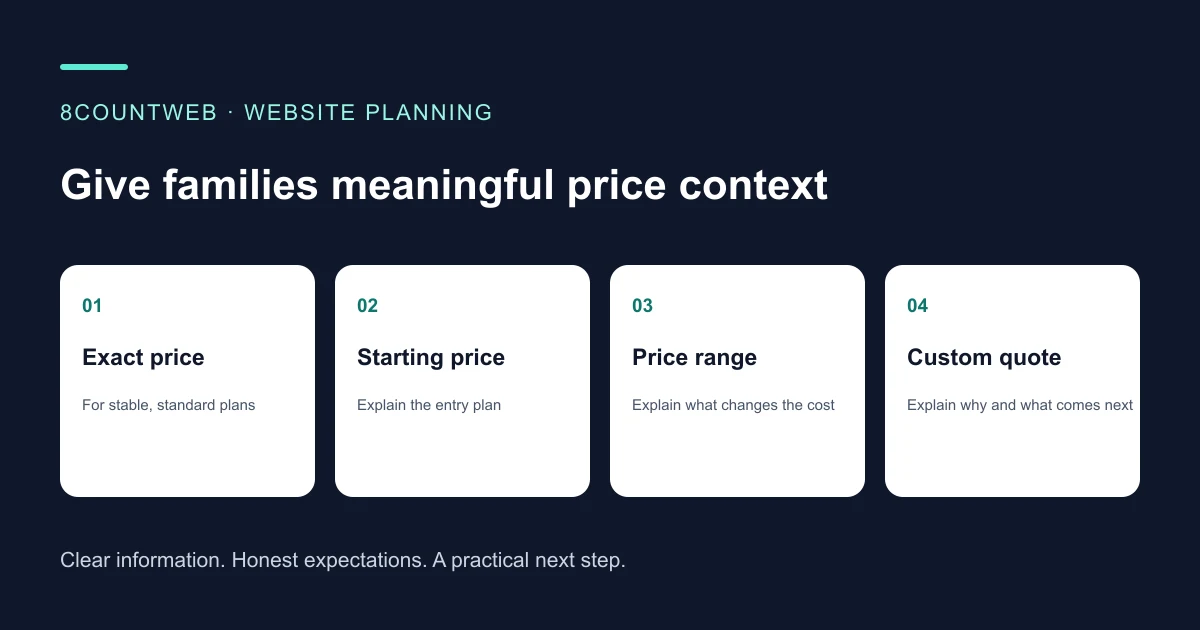
There are four reasonable ways to present tuition. Choose the most specific one your enrollment team can maintain:
Exact price
Use an exact price when standard plans have stable rates and clear eligibility. Explain billing frequency, term, classes included, and extra fees nearby.
Starting price
Use a starting price when a true entry plan exists but other options cost more. Explain what the starting plan includes and why other plans differ.
Price range
Use a range when several common plans vary in a predictable band. Explain which program choices move a family toward either end.
Custom quote
Use a custom quote when placement or an unusual schedule genuinely changes the offer. Explain why a quote is needed, what information you ask for, and when a family can expect an answer.
A starting price is not helpful if almost no prospective family qualifies for it. A range is not helpful if the website never explains what changes the price. And “contact us for pricing” leaves too much uncertainty when a school could reasonably describe its regular plans. These are editorial tests, not universal rules; the right choice depends on your actual offer.
Sidekick Martial Arts publishes plan prices and explains inclusions. This is an example of public price context, not evidence that one format produces more enrollments. Choose the format that accurately reflects your own school’s offer.
Put the price beside the program it describes
A new parent may see “kids martial arts” on one page, a trial form on another, and a membership price only after logging into a portal. Even if every piece exists, the path can feel disconnected.
Build the public explanation around the decision a family is making. On a youth-program page, pair price context with the age group, beginner fit, class frequency, location, what the child will do at the first visit, and the next action. On a tuition page, link back to each relevant program. Do not make a generic price table do the work of explaining the classes.
8CountWeb’s martial-arts website design service focuses on making programs, trials, pricing, schedules, and registration actions easier to find on a phone. A price explanation belongs in that journey, not in isolation.
Explain the costs beyond the monthly number
The monthly tuition may not be the whole decision. Depending on your school, a parent may need to understand registration fees, uniforms, belt testing, sparring equipment, event fees, family discounts, an introductory offer, or a minimum commitment. List only charges and policies that actually apply. If some are optional or vary by program, label them that way.
This is especially important when an offer says “free trial” or “first month.” State what happens after that period. A family should not have to infer whether the trial includes a uniform, whether the ongoing plan is month-to-month, or whether additional classes change the rate. Have the person responsible for tuition and enrollment approve the wording before it goes live.
Let the website explain; let the approved system calculate
Your registration or parent-portal tool may calculate a final amount after the family chooses a class, adds another child, or applies an approved discount. That is a sensible place for live account-specific totals. The public website still has a job: explain the pricing model, the common costs, and where the final amount will be shown.
Use a button that names the action, such as “View current classes,” “Book an introductory class,” or “Start registration.” If it opens a third-party registration system or requires a family account, say so. The class registration page guide covers the wider handoff from program information to enrollment.
Do not maintain two conflicting sources of truth. Assign a staff owner to review the public numbers and terms whenever tuition, programs, or promotions change. If the portal is the source of a final total, tell families that clearly before they click.
Does putting tuition in text help SEO or AI search?
Clear, public text gives search systems more context about what a page offers than a price that exists only after a login. But tuition alone is not an SEO tactic, and publishing numbers does not guarantee a ranking or AI-search mention.
Google’s people-first content guidance asks whether readers leave with enough information to accomplish their goal. Its AI-features guidance says important information should be available in text and pages should be findable through internal links; the same foundational SEO practices apply, with no special GEO markup requirement. For a local martial arts school, useful price context supports the parent decision first. Search clarity is a secondary benefit, not a promised result.
Give each page a distinct purpose. A program page explains the class and its fit. A tuition page explains common prices and conditions. A trial page explains the first visit. Link them with descriptive labels so families and search systems can follow the relationship.
Test the page before calling it finished
Ask someone unfamiliar with your school to use a phone and answer these questions without calling the front desk:
- Which program fits a beginner of their child’s age?
- What should they expect to pay, and what might change that amount?
- Are uniforms, testing, registration, or other relevant charges explained?
- Is the trial or first-visit cost clear?
- What does the main button do, and where does it lead?
- Who updates the page when a rate or policy changes?
If your team cannot answer those questions from the public page, the solution may be a focused rewrite or a cleaner link path, not necessarily a complete website replacement. 8CountWeb’s Registration Path Audit is a focused review of public pages, calls to action, and approved handoffs. It does not promise to rebuild the enrollment platform.
Make the next decision easier
A good martial-arts pricing page does not need to flatten every family into one plan. It needs to be honest about the normal path, specific about what a figure includes, and clear about when a final amount is determined. That helps a parent decide whether to explore the school further and helps your staff avoid explaining basic website gaps one inquiry at a time.
Contact 8CountWeb about your program and tuition path. Share your current program page, tuition approach, and trial or registration destination. We can identify where families have to guess and recommend a clearer next step.
Source links support factual claims; examples are not client endorsements. Explore more website resources.